

Table of Contents
- Why Jamaican Black Castor Oil Supports Hair Growth
- Jamaican Black Castor Oil Hair Growth Results Timeline
- What You'll Need Before You Start
- How to Apply Jamaican Black Castor Oil to Scalp: Step-by-Step
- How Often to Use Castor Oil for Hair Growth
- Common Mistakes to Avoid
- Pairing Castor Oil With Other Hair Care Products
- Frequently Asked Questions
Last Updated: September 26, 2026
Why Jamaican Black Castor Oil Supports Hair Growth
Jamaican black castor oil is a dark, thick oil made from roasted castor beans, and it has become one of the most talked-about natural remedies for thinning edges and slow-growing hair. We hear the same question constantly from customers: does it actually work, or is this just tradition dressed up as science?
Here's the honest answer. The oil won't magically sprout hair on a dormant follicle. What it does well is support the scalp environment where healthy hair grows. Its main fatty acid, ricinoleic acid, is a proven anti-inflammatory, and the oil's thick texture coats the hair shaft to reduce moisture loss.
The evidence for direct growth stimulation is thin.
What the Evidence Says vs. What Users Report
Most of the growth claims you see online come from personal testimony, not clinical trials. Users report thicker edges, less shedding, and faster length retention after consistent use over several months. Those reports are consistent and worth respecting.
Jamaican Black Castor Oil Hair Growth Results Timeline
Realistic expectations separate a good routine from a disappointing one. Hair grows in cycles, and the anagen phase, the active growth stage, runs for years. You will not see visible length in a week.
A typical timeline looks like this:
- Weeks 1-2: Scalp feels less dry and tight; hair may look shinier after each wash.
- Weeks 3-6: Less shedding during detangling and washing, especially at the edges.
- Months 2-3: New growth appears as short "baby hairs" along the hairline; breakage slows noticeably.
- Months 4-6: Length retention becomes visible because fewer ends are snapping off.
What You'll Need Before You Start
Gathering the right tools first prevents the mess and waste that turn people off oiling their scalp. You don't need much.
- A bottle of cold-pressed, unrefined Jamaican black castor oil
- An applicator bottle with a nozzle or a glass dropper
- A wide-tooth comb or detangling brush
- A spray bottle with water or a leave-in conditioner
- A small towel for your shoulders
- Optional: a plastic cap for deep conditioning sessions
How to Apply Jamaican Black Castor Oil to Scalp: Step-by-Step
Applying Jamaican black castor oil to scalp correctly takes about ten minutes and makes the difference between greasy buildup and real absorption. Follow these steps.
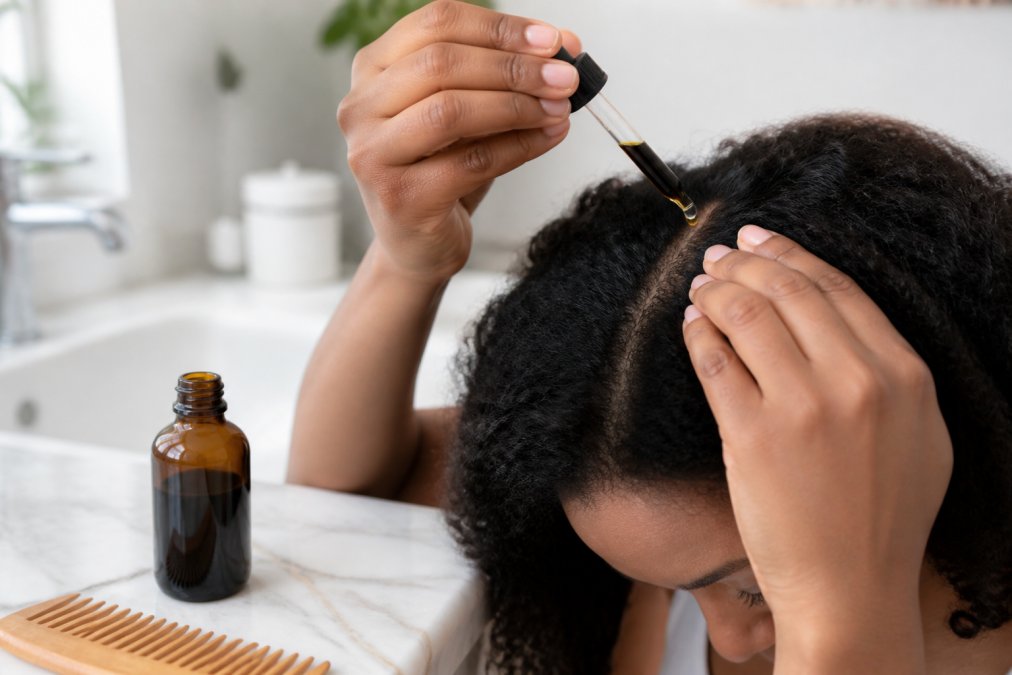
Total Time: 10-15 minutes Difficulty: Beginner
- Start on damp, not soaking wet, hair. Water helps the oil spread and reduces the amount you need.
- Section your hair into four parts using the comb, clipping each section out of the way.
- Fill the applicator bottle with oil, or draw a small amount into the dropper.
- Apply directly to the scalp in rows, about one inch apart, tracing along each part line.
- Massage the oil in with your fingertips using small circular motions for three to five minutes per section.
- Work any remaining oil down the strands to seal moisture into the hair shaft.
- Style as usual, or cover with a plastic cap for a deeper treatment.
DIY Scalp Massage Protocol for Better Circulation
Scalp massage is the step most people skip, and it's the one that does the most for scalp circulation. A simple protocol works better than random rubbing.
- Use the pads of your fingers, never your nails.
- Move in small circles from the hairline back toward the crown.
- Spend two minutes on each quadrant of your head.
- Finish with a gentle "pinch and lift" motion along the edges to stimulate blood flow.
Matching Application to Your Hair Porosity
Hair porosity determines how much oil your hair actually absorbs, and ignoring it is a common reason people end up with greasy, weighed-down hair.
How Often to Use Castor Oil for Hair Growth
Once or twice a week is enough for most people. Daily use sounds productive but usually backfires.
Adjust based on your scalp:
| Scalp Type | Frequency | Application Method |
|---|---|---|
| Dry, flaky scalp | 2x per week | Full scalp massage with warm oil |
| Oily scalp | 1x per week | Scalp only, avoid the roots after washing |
| High porosity hair | 2x per week | Scalp plus full length as a sealant |
| Low porosity hair | 1x per week | Diluted, scalp only |
Common Mistakes to Avoid
The biggest mistake is treating Jamaican black castor oil as a growth serum rather than a scalp and strand treatment. That mindset leads to over-application and disappointment.
Other pitfalls often seen:
- Using too much. A little goes a long way. Start with a few drops per section.
- Skipping the patch test. Castor oil is generally well tolerated, but a small test on your inner arm before a full application costs nothing.
- Never clarifying. Heavy oils need a clarifying wash every few weeks to prevent buildup.
- Expecting overnight results. Give any routine at least 90 days before judging it.
- Applying to a dirty scalp. Oil seals in whatever is already there, including dead skin and product residue.
Pairing Castor Oil With Other Hair Care Products
Castor oil works best as part of a routine, not as a solo act. The order you apply products changes the result, and so does what is already in the bottle you bought.
The layering order that actually works
Use it as a sealant after moisturizing, not before. Water-based leave-ins go on first, then a thin layer of oil locks that moisture into the hair shaft. Applied in the wrong order, the oil blocks the water from getting in at all.
The sequence for a wash-day routine:
- Cleanse with a gentle sulfate-free shampoo.
- Apply a water-based leave-in or moisturizer to damp hair.
- Seal with a thin layer of Jamaican black castor oil, focusing on the ends.
- Style as usual.
What to mix it with (and what to avoid)
Castor oil is one of the heaviest carrier oils, so mixing is often the difference between a treatment that absorbs and one that sits on top of your hair.
Good mixers, lightweight carrier oils:
- Jojoba, technically a liquid wax, closest to human sebum, absorbs quickly
- Grapeseed, very light, good for low porosity hair
- Sweet almond, medium weight, good slip for detangling
- Argan, light, adds shine without heaviness
Ingredients to look for on the label:
- "Cold-pressed" or "unrefined", indicates minimal processing and retained fatty acid content
- "Ricinus communis", the botanical name; if it is not listed, the oil may be diluted
- A short ingredient list, ideally just the oil, or the oil plus a preservative if it is a blend
Ingredients to be cautious about:
- Mineral oil or petrolatum listed before castor oil, these are cheap fillers that can coat the scalp
- "Fragrance" as a catch-all, a common irritant for sensitive scalps
- Alcohol denat. high on the list, drying, and it works against the oil's purpose
- Silicones (dimethicone, cyclopentasiloxane), not harmful, but they can mask whether the oil is actually absorbing
What not to pair it with
- Heat styling. Oil on the scalp before a flat iron or blow-dryer session can burn and damage the cuticle. Save oiling for wash days and overnight treatments.
- Protein treatments on the same day. Heavy oil can interfere with protein absorption. Space them at least a day apart.
- Strong chemical treatments. If you are relaxing, coloring, or texturizing, pause oiling for a few days before and after so the chemicals can penetrate evenly.
How to tell if your product is actually what it claims
Unrefined Jamaican black castor oil is thick, dark (amber to near-black), and has a distinct, slightly smoky or ashy smell from the roasted beans. If a bottle pours like water, looks pale, and smells neutral, it has likely been diluted or heavily processed.
Do not judge quality by price alone. A high price tag on a diluted or fragrance-heavy product is worse than an inexpensive, single-ingredient bottle. Read the ingredient list before the marketing copy.
The routine that works is simple: water-based moisture first, castor oil as the sealant, lightweight oil to dilute, and a clarifying wash every few weeks. Everything else is optional.
Frequently Asked Questions
How long does it take for Jamaican black castor oil to grow hair?
Most people notice reduced shedding and softer new growth within 4 to 6 weeks of consistent use. Visible length changes typically appear between 3 and 6 months because hair grows about half an inch per month on average. Results depend on your hair growth cycle, how regularly you apply the oil, and whether you massage it into the scalp to support circulation.
Will black castor oil actually grow your hair?
Castor oil does not create new hair follicles, but its ricinoleic acid and essential fatty acids can improve scalp health, reduce breakage, and support moisture retention along the hair shaft. Healthier strands break less, so length is retained. Think of it as a strengthening and scalp care tool rather than a magic growth serum.
Is it safe to use Jamaican black castor oil every day?
Daily use is generally safe for most people, but castor oil is thick and can clog pores if applied heavily. A few drops massaged into the scalp daily works for some, while others do better with 2 to 3 applications per week. If you notice buildup, dandruff, or irritation, reduce frequency and clarify your scalp regularly.
What is the best way to apply Jamaican black castor oil for growth?
Apply a small amount directly to the scalp using a dropper or fingertips, then massage in circular motions for 3 to 5 minutes to stimulate scalp circulation. Focus on thinning edges and problem areas. Leave it on for at least 30 minutes or overnight, then wash out with a gentle cleanser. Consistency matters more than quantity.