

Table of Contents
- What Is Raw Shea Butter and Why It Matters
- Raw Shea Butter vs Refined Shea Butter: What Changes
- Moisturizing and Skin Barrier Benefits
- Is Raw Shea Butter Comedogenic?
- How to Use Raw Shea Butter for Hair Growth
- Sourcing, Storage, and Shelf Life
- Frequently Asked Questions
Last Updated: September 27, 2026
What Is Raw Shea Butter and Why It Matters
Raw shea butter is the unrefined fat extracted from the nuts of the African shea tree, and it remains one of the most nutrient-dense skincare ingredients available. Unlike heavily processed versions, raw shea butter keeps its natural vitamins, fatty acids, and plant compounds intact. At Blackandproudclub, we carry wellness essentials like raw shea butter.
The benefits of using raw shea butter start with what it hasn't lost. Commercial refining strips out much of what makes shea effective in the first place.
The Difference Between Raw, Unrefined, and Refined
Raw shea butter is extracted by hand or with minimal mechanical pressing, then filtered. Nothing is bleached, deodorized, or heated to high temperatures. Unrefined shea butter follows a similar process but may be lightly filtered for consistency. Refined shea butter goes through chemical processing that removes color, odor, and many active compounds.
The practical difference shows up on your skin.
Raw Shea Butter vs Refined Shea Butter: What Changes
The main change between raw shea butter vs refined shea butter is what gets removed during processing. Refining typically uses solvent extraction (commonly hexane), high heat, filtration, and bleaching or deodorizing steps to produce a uniform, odorless, white butter with a longer shelf life. Each of those steps strips out a different part of what makes shea useful.
Here is what actually changes, category by category:
| Attribute | Raw Shea Butter | Unrefined Shea Butter | Refined Shea Butter |
|---|---|---|---|
| Extraction | Hand-cracked, hand-pressed, or minimally mechanical; filtered only | Similar to raw, often lightly filtered for consistency | Solvent extraction (commonly hexane) plus heat |
| Color | Ivory to pale yellow, varies by harvest | Ivory to pale yellow, slightly more uniform | Bright white |
| Scent | Distinct nutty, smoky aroma | Mild nutty aroma | Odorless |
| Vitamin A and E | Largely retained | Largely retained | Substantially reduced |
| Fatty acid profile | Oleic, stearic, linoleic, palmitic acids intact | Largely intact | Altered by heat and solvent exposure |
| Unsaponifiables (plant sterols, triterpenes) | Highest concentration | High | Reduced |
| Shelf life | 12-24 months unopened | 12-24 months unopened | Often 24-36 months |
| Best for | Treatment-focused skincare, hair sealing, DIY body butter | Everyday skincare and hair care | Neutral bases, scented products, large-batch manufacturing |
What Refining Actually Removes
The compounds refining targets are the same ones your skin benefits from. Vitamin A (as retinol precursors) and vitamin E (tocopherols) are heat-sensitive and largely degrade during deodorization. The unsaponifiable fraction, plant sterols, triterpene alcohols, and phenols, is what gives shea much of its anti-inflammatory reputation, and it is the fraction most reduced by solvent processing. What remains in refined shea is primarily the triglyceride base: still an effective emollient, but no longer a treatment ingredient.
The Practical Trade-Off
Refined shea is not a bad ingredient. It is a predictable one. If you are formulating a scented lotion, a lip balm, or a product where a nutty aroma would clash, refined shea gives you a blank canvas with a longer shelf life. If you are using shea for barrier repair, stretch marks, eczema-prone skin, or hair sealing, raw or unrefined is the version that carries the active compounds you are paying for.
A Note on "Raw" vs. "Unrefined"
In practice, the two terms overlap heavily. Most shea sold as "raw" is also unrefined; the difference is usually how much filtering happened and how the butter was handled after pressing. A true raw butter may still contain trace plant matter and will vary in color and scent from batch to batch. Unrefined butter is the same product with a lighter filter pass.
Moisturizing and Skin Barrier Benefits
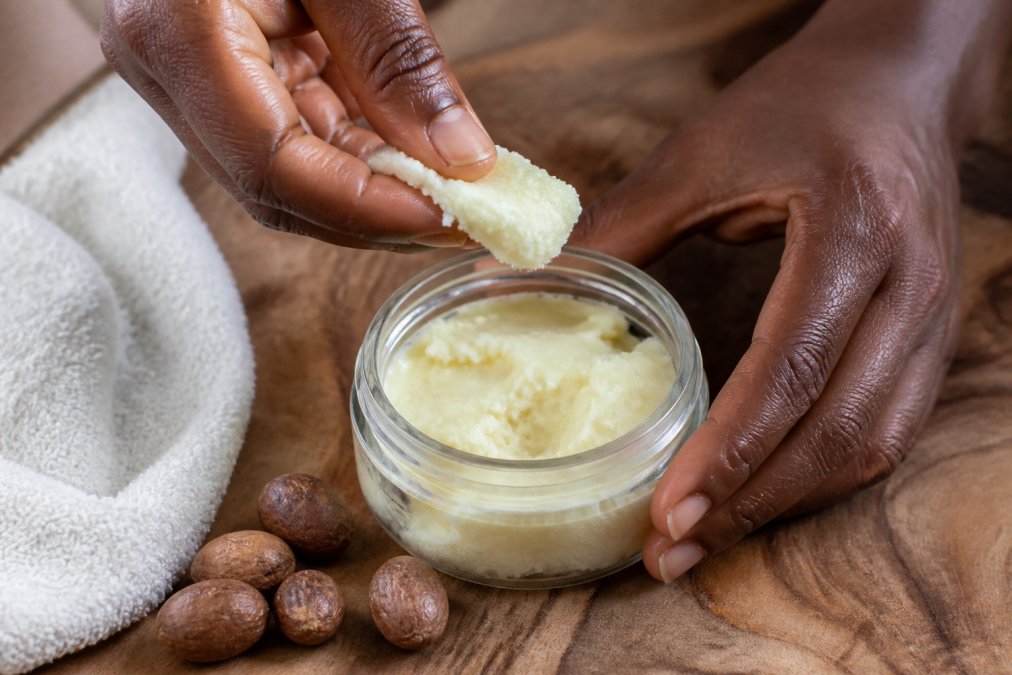
Raw shea butter moisturizes by mimicking the lipids your skin already produces. Its triglycerides and fatty acids absorb into the upper layers, reinforcing the lipid barrier that keeps moisture in and irritants out.
How Fatty Acids and Vitamins Support the Skin
The fatty acid profile in raw shea butter does the heavy lifting. Oleic acid softens and conditions. Stearic acid helps seal in moisture. Together they support elasticity and give skin a supple feel without a greasy residue once absorbed.
Is Raw Shea Butter Comedogenic?
Raw shea butter carries a comedogenic rating of 0 to 2 on the standard 0-5 scale, where 0 means "will not clog pores" and 5 means "highly likely to clog pores." Most published ratings place it at 2. That is low, but it is not zero, and the difference matters if you are acne-prone.
What the Comedogenic Scale Actually Measures
The scale rates how likely a raw ingredient is to cause comedones (clogged pores) when tested on rabbit ear or human skin models. It is a starting point, not a verdict. Several things change the real-world outcome:
- Concentration. A 100% shea butter balm behaves differently than a lotion with 5% shea.
- Your skin type. Dry and normal skin rarely reacts. Oily and acne-prone skin is more sensitive to heavy occlusives.
- What it is layered with. Shea over a silicone-heavy primer or under a thick sunscreen can trap more than shea alone.
- How much you apply. A pea-sized amount warmed between the fingers absorbs. A thick scoop sits on top of the skin.
Why Shea Sits Low on the Scale
Shea is high in stearic and oleic acids. Stearic acid is a saturated fat that forms a breathable, semi-occlusive film rather than a fully sealed barrier. Oleic acid is the one to watch, it is a known penetration enhancer and, at high concentrations, can be problematic for some acne-prone users. In shea, oleic acid is present but balanced by stearic and palmitic acids, which is why the overall rating stays low rather than high.
How to Use It If You Are Acne-Prone
- Patch test on your jawline or behind the ear for three to five nights before using it on your full face.
- Apply at night, after cleansing, on damp skin, a pea-sized amount is enough for the entire face.
- Skip it on active breakouts and use it on dry patches, cheeks, or the perimeter of the face instead.
- If you wear makeup, use shea at night only. Daytime layering under foundation is where most clogged-pore complaints originate.
- Give it two weeks. If you see new closed comedones along the jaw or forehead, drop to body use.
Body vs. Face
On the body, the comedogenic question is largely moot. The skin on your legs, arms, and torso is thicker, has fewer sebaceous glands per square inch, and is far less prone to congestion. Raw shea butter is an excellent body butter, cuticle cream, and heel treatment regardless of your facial skin type. Save the caution for the face and the upper back.
How to Use Raw Shea Butter for Hair Growth
Raw shea butter supports hair growth by conditioning the scalp and protecting the hair cuticle from breakage. It doesn't directly stimulate follicles, but healthy scalp conditions and reduced breakage make a visible difference in length retention over time.
A Simple Routine for Scalp and Strands
- Warm a small amount between your palms until it melts
- Massage into your scalp in circular motions for two to three minutes
- Work the remainder through your strands, focusing on dry ends
- Cover with a satin cap or scarf and leave overnight
- Wash out in the morning with a gentle cleanser
Repeat this two to three times per week. For protective styles, use raw shea butter as a sealant after applying a water-based leave-in conditioner. The butter locks in hydration and keeps the hair cuticle smooth.
Sourcing, Storage, and Shelf Life
Where your raw shea butter comes from matters as much as how you use it. Look for cold-pressed or hand-processed shea, which supports fair trade and preserves the butter's nutrient content.
Frequently Asked Questions
What are the primary benefits of using raw shea butter versus refined?
Raw shea butter keeps more of its natural fatty acids, vitamin A, and vitamin E because it is not heavily processed. That means it can support skin barrier function and hydration more effectively than refined versions, which lose some nutrients during filtering and deodorizing. Raw shea butter also has a nutty scent and ivory color, while refined is white and odorless.
Is raw shea butter comedogenic, and can it clog pores?
Raw shea butter has a moderate comedogenic rating, around 2 on a 0 to 5 scale. That means it is unlikely to clog pores for most people, but those with very oily or acne-prone skin may want to patch test first. Its stearic and oleic acid content makes it an emollient that seals in moisture without feeling heavy when used in small amounts.
How do I use raw shea butter for hair growth?
Warm a small amount in your palms and massage it into your scalp and ends two to three times a week. Focus on the scalp to support circulation and scalp health, then work the remainder through your strands to protect the hair cuticle. Raw shea butter is not a growth stimulant on its own, but it reduces breakage so hair can retain length.
What is the best way to store raw shea butter to maintain its benefits?
Keep raw shea butter in an airtight glass jar away from direct sunlight and heat. A cool, dark cabinet works well, and refrigeration can extend shelf life to about two years. If it melts during shipping, let it cool at room temperature and stir it back to a smooth texture. Avoid storing it near strong odors, since it can absorb smells.
Raw shea butter rewards you for choosing quality and storing it well. The challenge is finding a source you can trust for authenticity and ethical sourcing. Blackandproudclub offers wellness essentials like raw shea butter alongside culturally meaningful jewelry, fashion, and home decor, all curated to celebrate heritage and support your self-care routine. Explore the collection at Blackandproudclub and bring home products that honor both your skin and your story.